The Hidden Path: Lateral Movement Through IAM Trust Policy Modification
By Jean-Yves PASQUIER on
When security teams audit cloud permissions, they typically focus on what actions each identity can perform. Can this role read from that S3? Can that user modify these serverless functions? This approach makes sense—it maps directly to how we think about access control. But it misses a crucial category of permissions: those that don’t grant access directly, but enable an attacker to create access where none existed before.
The iam:UpdateAssumeRolePolicy
permission (with equivalents in
Azure
and GCP)
is one such capability. It doesn’t let a user assume a role or access any
resource directly.
Instead, it lets them modify who can assume a role. That
distinction makes it one of the most dangerous and overlooked
lateral movement vectors in complex cloud environments.
Let’s take a closer look at how it works with an example on AWS.
Understanding IAM Role Trust Policies
AWS role assumption works through a dual-policy mechanism. When a principal attempts to assume a role, AWS evaluates two separate policies:
- Identity-based policy: Does the calling principal have permission to call
sts:AssumeRoleon the target role ? Not that it can be optional for role assumtion when the assumer is the same as the role owner. - Trust policy: Does the target role’s trust policy list the calling principal as a trusted entity?
Both conditions must be satisfied for the assumption to succeed. The trust policy lives on the role itself as its “assume role policy document” and defines which principals (users, roles, services, or even external AWS accounts) are allowed to assume that role.
This dual mechanism provides defense in depth—you need both the caller to have permission to assume and the role to trust the caller. However, it also creates a non-obvious attack surface: what happens when someone can modify the trust policy itself?
The UpdateAssumeRolePolicy Attack Vector
An attacker with the iam:UpdateAssumeRolePolicy permission can perform lateral
movement in two steps:
Step 1: Modify the trust policy
The attacker adds their own principal (or one they control) to the target role’s trust policy. This is a single API call that immediately takes effect.
Step 2: Assume the role
With the trust policy now permitting them, the attacker assumes the role and inherits all of its permissions.
Here’s what this looks like in practice using the AWS CLI:
# Step 1: Modify the trust policy to add attacker's principalaws iam update-assume-role-policy \  --role-name TargetRole \  --policy-document '{    "Version": "2012-10-17",    "Statement": [{      "Effect": "Allow",      "Principal": {        "AWS": "arn:aws:iam::123456789012:user/attacker"      },      "Action": "sts:AssumeRole"    }]  }'
# Step 2: Assume the roleaws sts assume-role \  --role-arn arn:aws:iam::123456789012:role/TargetRole \  --role-session-name AttackerSession
This attack is particularly dangerous for several reasons:
- Speed: A single API call modifies the trust relationship, and assumption is immediate
- Bypasses existing restrictions: It doesn’t matter who the role currently trusts—the attacker rewrites the trust policy entirely
- Persistence: The modified trust policy remains in effect until someone notices and reverts it. A smart attacker would simply add a new principal to the trust policy, which would not break any existing workflow. This allows them to go unnoticed for a long time.
- Audit blind spots: Permission audits that only examine current trust relationships won’t flag the risk
Why Traditional Analysis Misses This
Most security tools answer the question: “Who can assume this role?” They do this by reading the role’s current trust policy and mapping the trusted principals. This approach has a fundamental limitation: it only shows the current state of trust relationships, not who could modify them.
The permission to call iam:UpdateAssumeRolePolicy exists on identity-based
policies attached to users and roles, not on the trust policy itself. Auditing
a role’s trust policy only reveals who is trusted right now. The real risk
often lies with principals who aren’t currently trusted but could add
themselves to the list.
This creates a blind spot: a principal with zero current access to a role can grant themselves full access with a single API call. Traditional tools that only enumerate existing trust relationships will never surface this path.
Mapping the Full Attack Path
To understand the true risk landscape, security analysis must consider both dimensions:
| Analysis Type | Question Answered | Tools Typically Check |
|---|---|---|
| Trust relationship analysis | Who can assume this role today? | Yes |
| IAM action analysis | Who can modify this role’s trust policy? | Often missed |
The combination reveals attack paths invisible to simple reachability analysis.
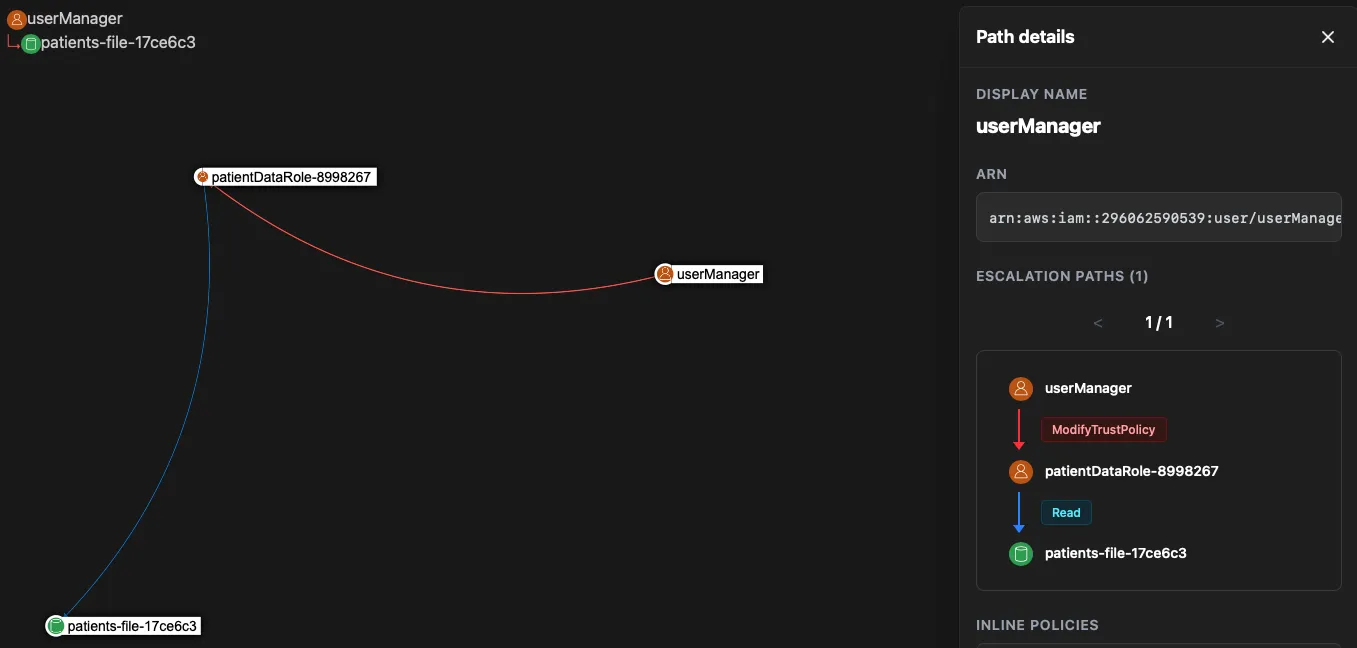
A developer role might have iam:UpdateAssumeRolePolicy permission
on production roles for legitimate infrastructure automation. That developer
role becomes a pivot point: compromising it grants access not just to what it
can do directly, but to everything the production roles can access.
Graph-based visualization makes these indirect paths visible. Security teams can trace the full attack chain: a compromised identity that can modify the trust policy of a target role, which in turn has access to sensitive resources.
Why Restricting AssumeRole Isn’t Enough
A natural defensive response is to restrict which principals can call
sts:AssumeRole on sensitive roles. You might create identity-based policies
that deny certain users or roles from assuming critical roles. However, this
defense has a significant gap when combined with trust policy modification—a
variant of the confused deputy problem.
Consider this scenario:
- An attacker compromises a principal with
iam:UpdateAssumeRolePolicypermission on a sensitive role - The attacker cannot assume the role directly—there’s an explicit deny in their identity-based policy
- The attacker modifies the trust policy to trust an external AWS account they control
- From that external account, the attacker creates any principal they want
- That external principal assumes the role, bypassing all identity-based restrictions in the victim account
The key insight: the attacker doesn’t need to compromise an existing trusted principal—they can create one. Identity-based denies in the victim account have no effect on principals in other accounts. The only thing that matters for cross-account assumption is the trust policy, which the attacker now controls.
This is why iam:UpdateAssumeRolePolicy is not just a privilege escalation
risk within an account—it’s a potential entry point for external attackers to
establish persistent access.
Defense in Depth: SCPs and RCPs
Defending against trust policy modification attacks requires layered controls that operate at different levels of the AWS authorization model.
Service Control Policies (SCPs)
SCPs
apply at the AWS Organizations level and can restrict which principals can
call iam:UpdateAssumeRolePolicy across your entire organization:
{ "Version": "2012-10-17", "Statement": [ { "Sid": "RestrictTrustPolicyModification", "Effect": "Deny", "Action": "iam:UpdateAssumeRolePolicy", "Resource": "*", "Condition": { "StringNotLike": { "aws:PrincipalArn": [ "arn:aws:iam::*:role/InfrastructureAutomationRole" ] } } } ]}This approach limits trust policy modification to specific, tightly controlled roles, reducing the attack surface significantly. See the SCP examples documentation for more patterns.
Resource Control Policies (RCPs)
RCPs provide a second line of defense by restricting who can assume roles in your account, regardless of what the trust policies say:
{ "Version": "2012-10-17", "Statement": [ { "Sid": "DenyExternalAssumption", "Effect": "Deny", "Principal": "*", "Action": "sts:AssumeRole", "Resource": "*", "Condition": { "StringNotEquals": { "aws:PrincipalOrgID": "o-your-org-id" } } } ]}Even if an attacker modifies a trust policy to trust an external account, the RCP blocks the actual assumption. This prevents the external account pivot described earlier. See the RCP examples documentation for additional patterns.
Additional Mitigations
- CloudTrail monitoring allows security teams to create alerts on
UpdateAssumeRolePolicycalls, especially those that add external principals or wildcard trusts. - Permission boundaries limit the scope of what roles can do even if their trust policies are modified.
- Regular audits should include trust policy modification permissions in privilege escalation assessments, not just current trust relationships.
The layered approach is essential: SCPs prevent the modification where possible, RCPs block exploitation if modification occurs, and monitoring provides visibility into attempted attacks.
Detecting Prior Compromises
What if the attack already happened before you deployed security tooling? Trust policy modifications don’t trigger alerts retroactively, and CloudTrail logs are often retained for only 90 days. An attacker who modified a trust policy months ago may have established persistent access that traditional audits won’t catch.
This is where graph-based analysis becomes invaluable for detection, not just prevention. When PanIAM maps your environment’s trust relationships, any role trusting an external account outside your organization appears as an inbound edge from an unknown principal, highlighted in red. These edges immediately stand out: why would a production role in your account trust an AWS account you don’t recognize?
In a healthy environment, cross-account trust should only exist with:
- Other accounts in your AWS Organization
- Known partner or vendor accounts with documented business relationships
- AWS service principals for legitimate integrations
Any trust relationship outside these categories warrants immediate investigation. It could be a legitimate configuration you forgot about, or it could be evidence of a prior compromise where an attacker added their external account to maintain persistent access.
The graph makes this anomaly visible at a glance. Instead of manually reviewing hundreds of trust policies line by line, you can spot the suspicious red edge pointing to an unknown account and trace exactly which roles are affected and what those roles can access.
Thinking Like an Attacker
Attackers don’t analyze permissions in isolation—they think in graphs and paths.
A permission that seems innocuous on its own might be the critical link in a
chain leading to sensitive data. The iam:UpdateAssumeRolePolicy permission
is a prime example: it grants no direct access to anything, but it can unlock
access to everything a target role can reach.
Security teams need the same graph-based perspective. Understanding your environment’s attack paths requires modeling not just what each identity can access today, but what access they could create through indirect actions. Without this view, defenders are perpetually one step behind attackers who naturally think in these terms.
At PanIAM, we model these indirect paths to surface lateral movement opportunities that traditional permission analysis misses. The permissions that matter most aren’t always the ones that grant access—sometimes they’re the ones that let attackers grant it to themselves.
Related posts

Stay Tuned
We write about attack paths, what's worth fixing first, and the new risks AI agents bring to your cloud, every two weeks.
Subscribe Now